Cobots
Collaborative robots (Cobots) are popular in industry because they enable close collaboration between a human and a robot. Although a cobot can stop when a collision happens, it is not pleasant or safe for the human to be hit by the cobot multiple times a day. In this research, we use inexpensive proximity sensors on the cobot to detect obstacles to generate motion decisions, including using Machine Learning algorithms.
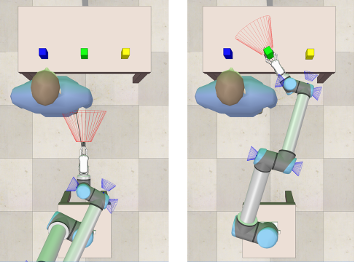 The cobot picks up a finished part from one table and attempts to put it on another table but the the human operator is in the way. Our algorithms can generate updated motion paths for the cobot based on sensing the operator to attempt to go around him to reach the target delivery position.
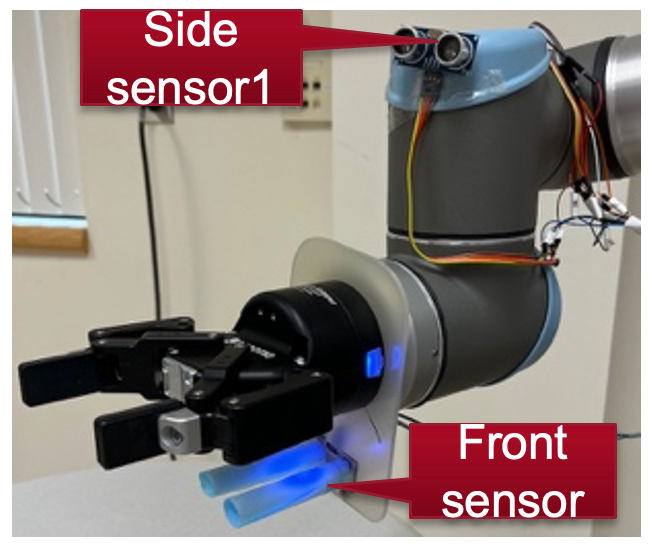
Inexpensive ultrasonic sensors are used near the fingertips and joints of the UR10 cobot.
Publications
- “Collision Avoidance in Human-Cobot Work Cell Using Proximity Sensors and Modified Bug Algorithm,” 10th International Conference on Control, Mechatronics and Automation (ICCMA), Luxembourg, November 2022
- “Automatic Inspection of Green Concrete Quality Using Machine Learning and Cobot”, 5th International Conference on Mechatronics, Control and Robotics, Jeju, Korea, February 2022
- “Modified Bug Algorithm with Proximity Sensors to Reduce Human-Cobot Collisions,” 9th International Conference on Automation, Robotics and Applications (ICARA), Abu Dhabi, United Arab Emirates, 2023
- “Tool Path Adaptation of a Cobot Using Supervisory Control with Machine Learning,” 11th International Conference on Control, Mechatronics and Automation (ICCMA), Grimstad, Norway, 2023