2026 WSU Vancouver Marine Invertebrate Communities (Biol 486) blog
Beginning on 15 May 2026, a group of WSU Vancouver students will take part in a field course to observe marine invertebrates in their native habitats using a natural history and ecological approach. We will explore communities along the southern Oregon coast ranging from the rocky intertidal habitat at Cape Blanco to the sand dunes north of Coos Bay. Sandy beaches, estuaries, and mud flat communities will also be explored. Participants will reside and work at a marine lab on the southern Oregon coast.
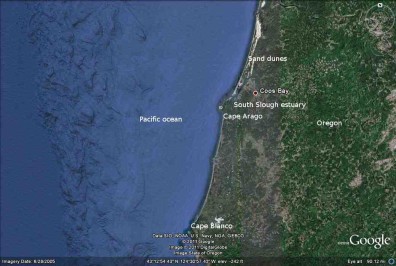
This blog will describe the activities and habitats explored by Marine Intertidal Communities participants.
Friday – 15 May 2026
Mike Berger
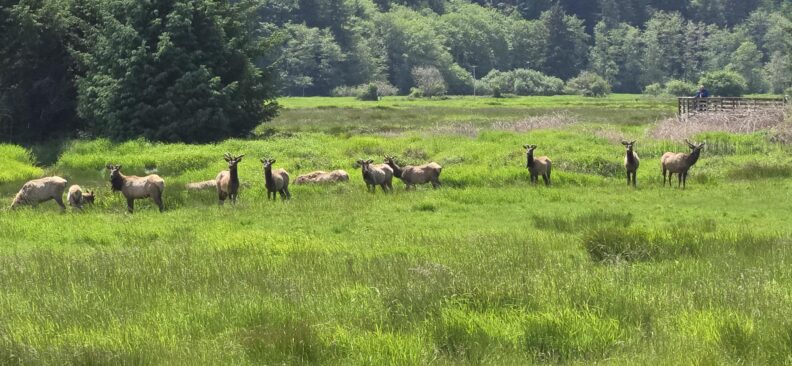
Biol 486 participants started the day at 7:30 am by loading the van with equipment and gear. Although challenging, we managed to find space for everything and everyone. We departed ahead of schedule, with Eugene, OR, as a midpoint break to stretch our legs and eat some lunch. As we approached the coast, we stopped for another stretch and to observe a herd of elk at the Dean Creek Elk Viewing Area.
We arrived at OIMB after a short 45-minute drive from the elk viewing area. Upon arrival, we sorted out classroom and lodging space, along with a tour of campus. Then we unloaded all of our equipment and started to get the classroom set up.
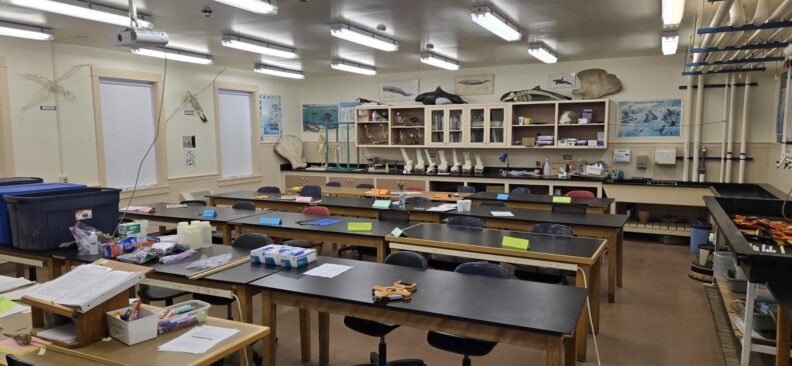
Everyone took a few minutes to walk around campus and get settled into their respective cottages. Prior to dinner, we met as a group to discuss plans for the week and to go over our objectives for the remainder of the evening, which included dinner, discussing the work we planned to do on Saturday measuring diversity in the intertidal ecosystem, and a discussion on creativity and natural history in science. As we were about to dive into things, the dinner bell rang, so off to dinner we went for a meal of baked salmon and rice.
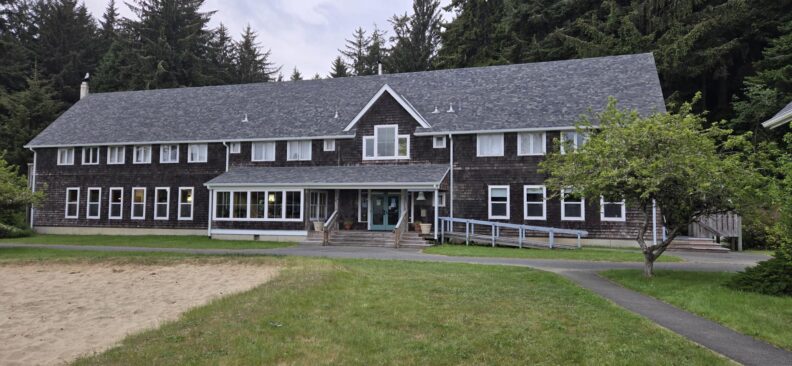
OIMB Dining hall.
Following dinner, we continued our discussion, gathered all of our equipment for going out into the intertidal the next morning, and loaded the van, since we will start the day at 5:15 am to catch the low tide!
Saturday morning – 16 May 2026
Sam Thompson
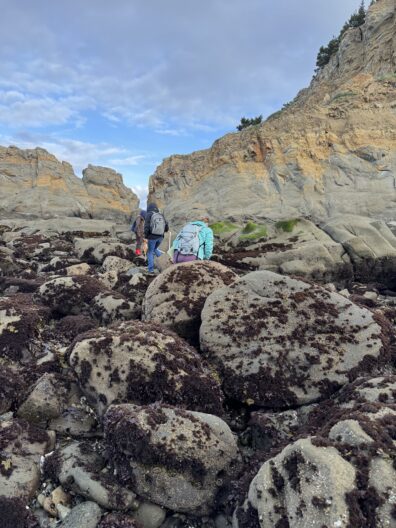
Saturday morning began with an early call time of 5:15am, well before the sun was up here at the Oregon Institute of Marine Biology. Everyone bustled their way out to the van, and we began our journey down to Cape Arago South Cove, the perfect representation of a rocky intertidal habitat. The day turned out to be a warm sunny day, following the small sprinkles that we experienced part way through our field work.
Making our way down to the beach proved to be mildly difficult as we had to slightly propel a rope left behind specifically for that purpose to gain beach access. The early morning start-time coincided perfectly with low tide, so we were able to reach areas and observe organisms seemingly unimaginable. Walking across the rocks within the intertidal zone made the previous rope trek seem like a walk in the park; lots of stumbling and slipping, some falls, but a whole lot of fun!
We were given the opportunity to explore the intertidal zone here at Cape Arago to further examine the biodiversity of the ecosystem. We quickly came to realize that there is not much in the way of open space for newcomers to move into. Almost every square inch across the rocks was inhabited by either pacific purple sea urchins, giant green anemone, or wrinkled & gooseneck barnacles. Sprinkled between these spaces wherever they could find some room were quite a few groupings of California barnacles and several species of sea stars; Ochre, Pacific Blood, and the Bat Sea star. We also located a couple species of Chiton; the Hind’s Chiton, and my favorite find of the day was the Gumboot Chiton!
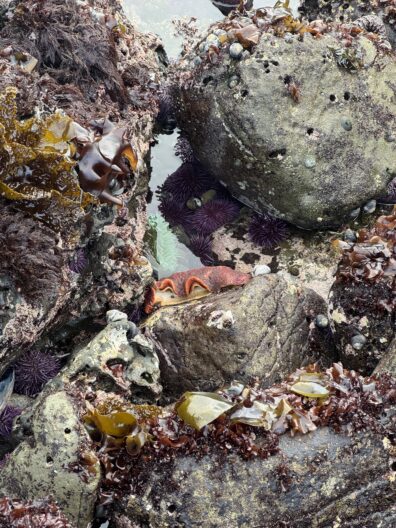
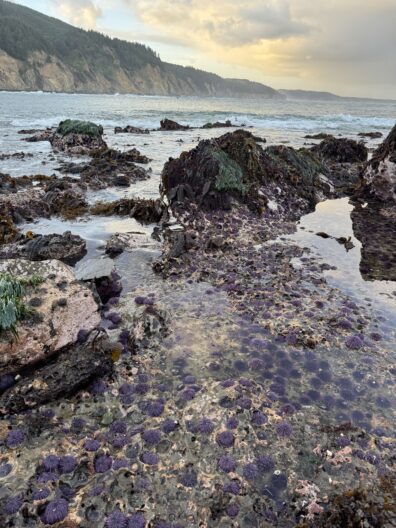
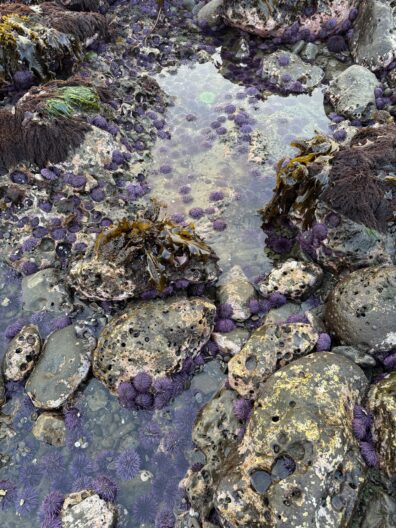
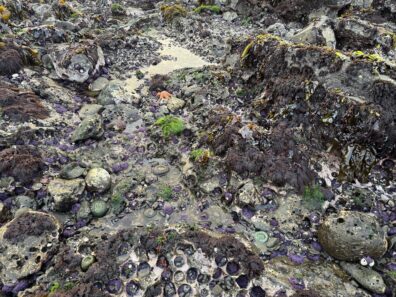
While we were traversing over the rocks, Dr. Berger kept finding and pointing out neat invertebrates to us, one of which was a Green Abalone, which has come to be a rare find these days! He also demonstrated how an anemone navigates food (a mollusk sacrifice) from their tentacles into their mouths and close while they digest their recent meal.
After we thoroughly explored the area before us, we measured 5 meter transects and placed a quadrat at each of the 2-meter markings to determine the different biomass percentages of the different species found. We then measured the height of the transect at the intertidal zone, as well as the height of the tide at that time. We then repeated this same process at a higher level within the tidal zone.
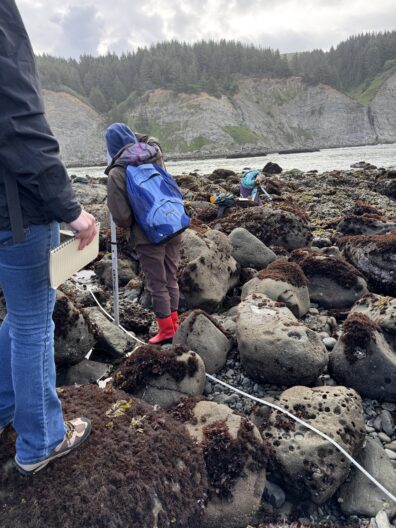
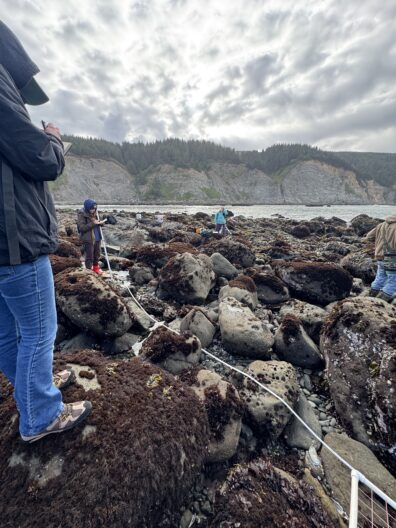
Once all our measurements were recorded, we decided to make our way back up to the van and off to our next adventure!
Saturday afternoon – 16 May 2026
Lilli Waite
After a much-appreciated lunch at around 1pm the group headed out once more, this time to visit Lighthouse Beach. This beach had been closed to the public for a while, so it was exciting that the class had the chance to visit it now. This sandy shore habitat had a beautiful view of a lighthouse in the distance, presumably giving it its name.
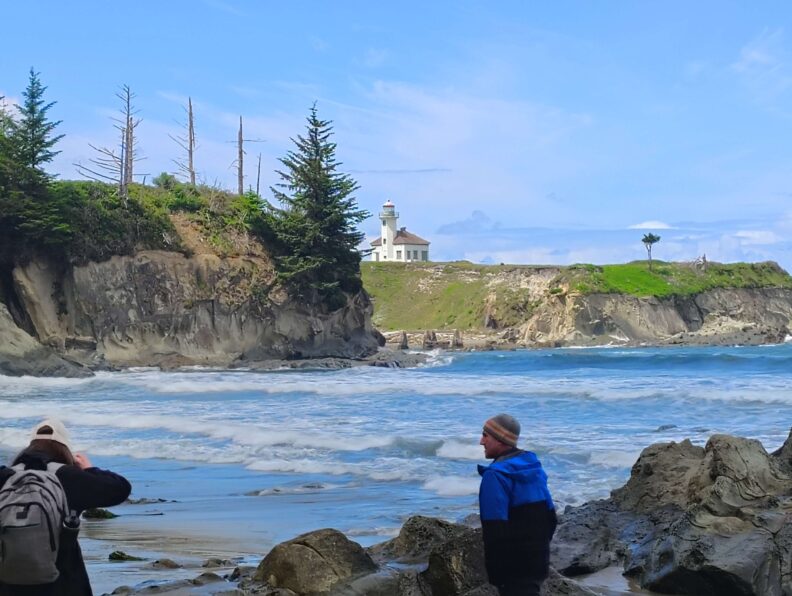
On this beach, the class went exploring with buckets and shovels. We were on a mission to find creatures in the sand; particularly mole crabs. These little crabs pop up out of the sand to collect food particles when water from the waves passes over them, before quickly burrowing again. This made it quite the race to watch the waves and dig up a crab when we saw one. We collected some, and placed others back on the sand to watch how quickly they went back underground. We also encountered many small isopods that were easier to find. Some would jump chaotically, while others slowly buried themselves.
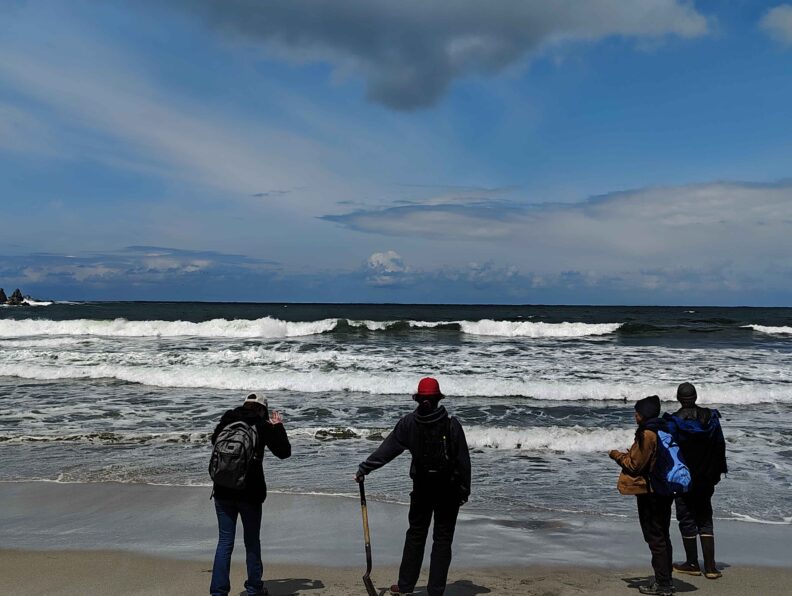
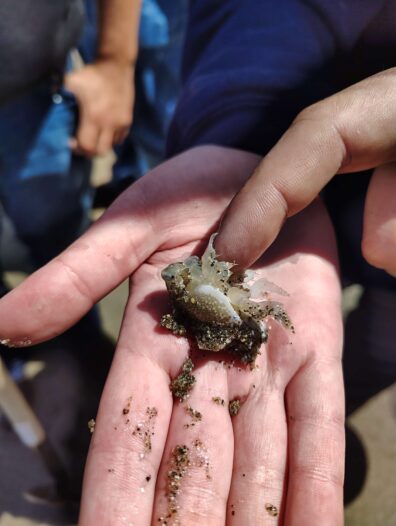
While there we also saw many beautiful geological features, and many pelicans in the distance.
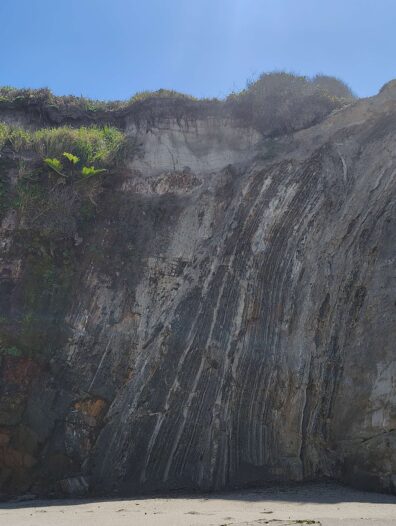
After exploring for a while, we headed back to OIMB. We had a bit of downtime to dry ourselves off before discussing how climate change can impact marine ecosystems. Then, after a long and interesting day, we headed into the dining hall for baked lasagna and started preparing ourselves to visit our next habitat at 6 am the next morning.
Sunday Morning- 17 May 2026
Ron Clark
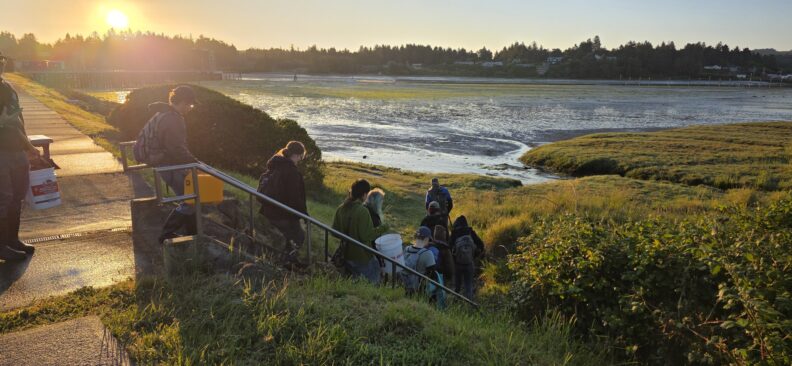
It was a cold, early start this morning. The biology 486 students rolled out of bed as the sun rose, meeting in the classroom at 6:00 to gear up and walk to the nearby mudflats to take advantage of the morning low tide. Although the early wake-up call came, excitement and caffeine helped some of us get moving.
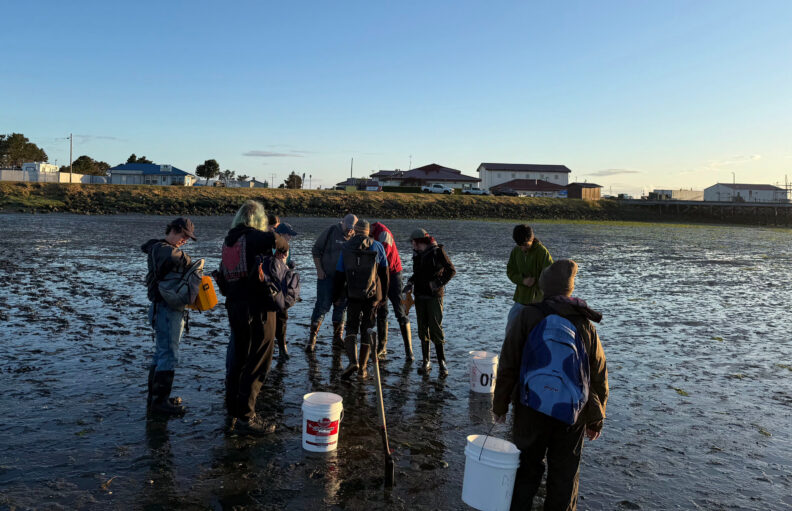
Upon arrival, we spread out across the mud flats armed with shovels, buckets, and curiosity. At first glance, the mud flat looked quiet and mostly empty, but it quickly became clear that an entire community of organisms was hidden beneath the surface. By digging into the sediment and carefully sifting through the mud, we began uncovering many of the animals that make this habitat their home.
As the morning continued and hole after hole was dug, several dozen clams were found buried beneath the sediment along with numerous marine worms weaving through the mud. Small crabs also appeared during our search, often moving quickly through shallow pools or attempting to disappear into thick clumps of seaweed clinging to the old pylons. Every scoop of mud felt like a surprise, and no one knew exactly what might appear next. It was interesting to see how much life existed beneath what initially looked like a simple stretch of mud and sand.
Beyond finding organisms, the experience highlighted the importance of these estuarine mudflat habitats. While they may not seem as visually dramatic as rocky shorelines or sandy beaches, mud flats support a wide variety of species and provide shelter, feeding grounds, and habitat for countless organisms. On the walk back, everyone was muddy, a little tired, and much more appreciative of the hidden communities living beneath our feet.
Lunch awaited us back on campus, providing a good chance to relax and gather ourselves before afternoon class.
Sunday Afternoon- 17 May 2026
Isabelle Gruginski
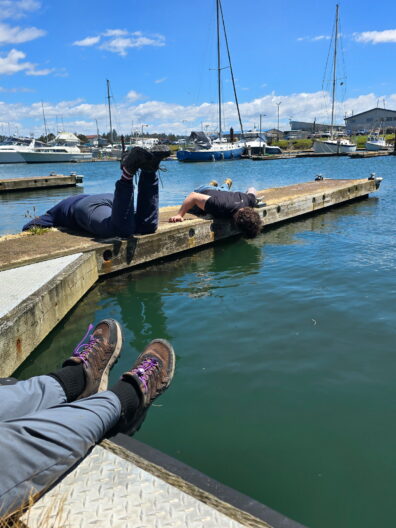
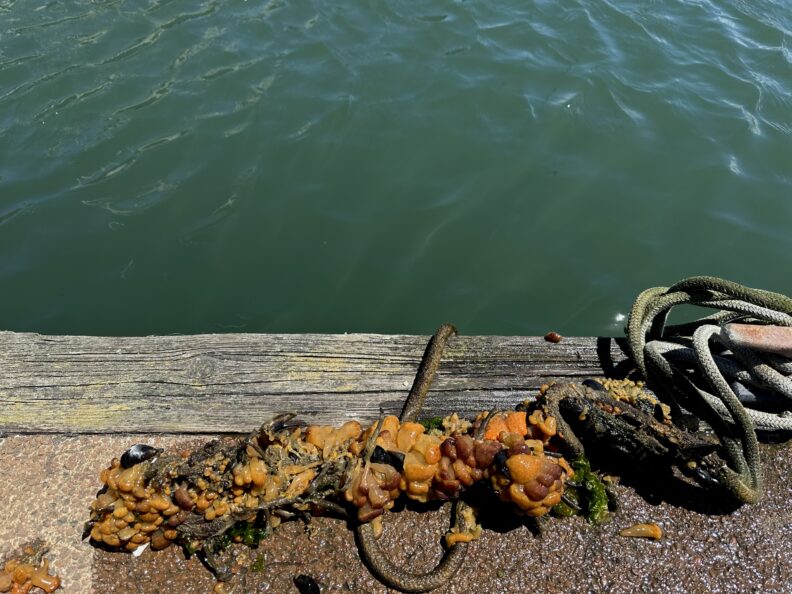
After cleaning up from a morning exploring the mud flats, we had lunch and walked to the boat docks just below OIMB. We brought buckets and butter knives to assist with our endeavors. This time our goal was to retrieve specimens cemented to the boat docks to bring back into our lab and study. At the docks we found a variety of marine invertebrates including mussels, sponges, anemones, sea squirts, star fish, chiton, and tube worms. The undersides of the docks were covered in mussels that had become the binding surface for many of these other invertebrates to call home. We also pulled up abandoned rope to see what had attached themselves and found an abundance of colonial ascidians. They were orange in color and resembled mushrooms. Everyone enjoyed investigating this environment even though some of us got dizzy from the moving water.
When we were satisfied with our findings, we packed our buckets of invertebrates back to the lab. When we got there, we picked from the specimens we just collected as well as those collected earlier in the week to study. We used dissecting microscopes to get a closer look at our organisms. The results were astonishing; we could clearly see details that had completely evaded our observations with the naked eye. To study the flow of water through sponges and sea squirts, we pipetted fluorescein dye in the water directly above them and watched as they absorbed the dye and expelled it in a high velocity stream. We also observed bivalves we had taken from the mud flats and looked for pea crabs which are small crustaceans that live in bivalves. One group found two pea crabs living inside of the bivalve they opened. When we finished in the lab, we washed up and got ready for dinner.
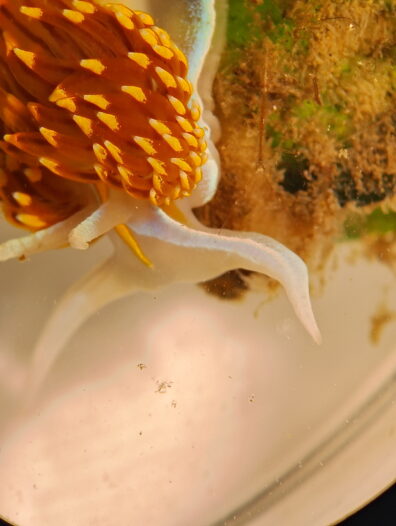
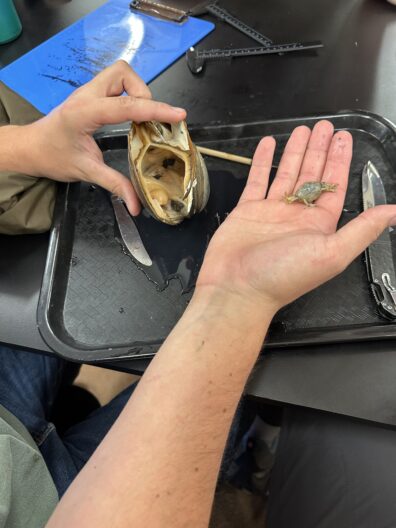
After dinner, we had time to work independently. Some students chose to revisit the mud flats, some headed out to the beach, others discussed research projects, and a few used the time to take another look at their organisms under a microscope. After our independent studies we got ready for the next morning, which we were all glad to see started a little later.
Monday Morning – 18 May 2026
Angelica Perov
It was a beautiful, sunny, and relatively warm morning. The winds were low as we walked over to the 7:30am breakfast. It may have been a normal or early wake-up time back home, but for us, it was a blissful opportunity to sleep in just a bit.
As we ate, we discussed the plan for today. These amazing weather conditions were also the possible doom of our first mission: some offshore benthic trawling on the ship R/V Megalopa. 48 feet long and 17 feet across, this ship was not well-suited for swells produced by strong winds. Unfortunately, our beautiful morning provided the conditions for exactly that.
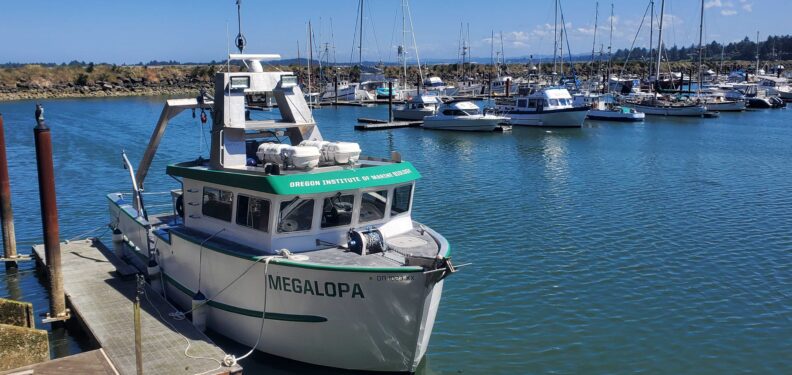
As the land air mass warmed and rose quicker than the ocean air mass, the cold (denser) ocean rushed in to replace it, producing wind. In the early morning, this temperature/pressure difference was not as pronounced, but as the day progressed, the winds were expected to pick up more and more speed. Our captain was hopeful that we could sneak in a few trawls during the narrow morning window, so we loaded onto Megalopa shortly after 8am and embarked on our adventure out to the open ocean.
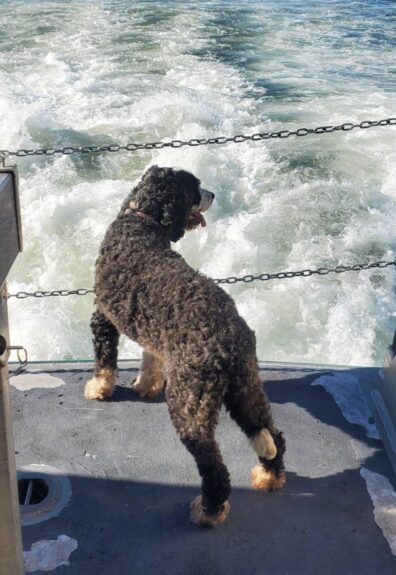
Aboard, we were greeted by the rarest marine specimen we had come across so far: a sea dog. Her name was Scout, and she made many rounds around the boat to make sure things were in order. Thanks to her diligence, not a single thing was out of place for the entire trip. No one threw up, nor did anyone fall overboard. We couldn’t have done it without her.
The waves were calm within the bay, but as we approached the bar, they picked up in size and intensity. Megalopa rocked not just up and down, but also side to side. After enduring about ten minutes of this, the captain made the wise decision to turn back around. The captain took us into the bay where conditions were much more calm. Our goal for the trip was to do some benthic trawling and observe life from the bottom of the bay. Kersten, the graduate student guiding us on this expedition, called out orders as student volunteers worked together to lower the trawl and A-frame.
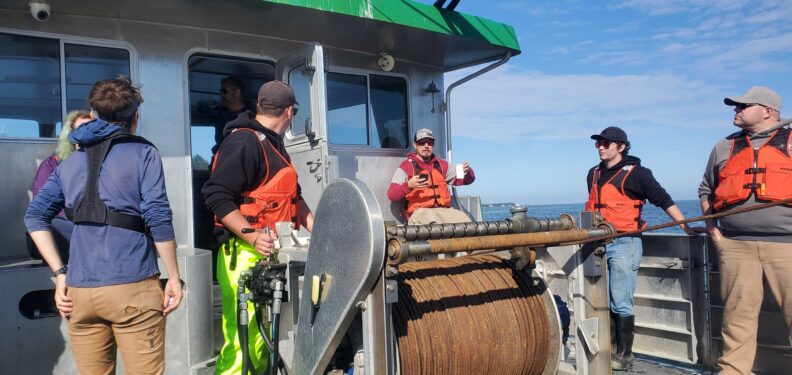
After waiting roughly ten minutes, they raised it back up and deposited the goodies in a sizeable observation basin. Then, the most difficult part… waiting until everything was set back into position before getting to dig through the haul was agonizing, but we managed.
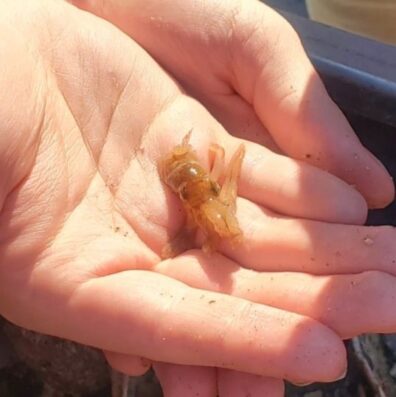
Our patience was rewarded by all sorts of things! Rock crabs with crazy line patterns, pisasters, ochre stars, shrimp, nudibranchs, macroalgae, colonial organisms, and hundreds of baby Dungeness crabs. It was the marine biology equivalent of Christmas morning! Of course, we had to dig through the mucky sediment and tons of empty clam and cockle shells to get to any of it (aside from the baby crabs, those crawled out on their own).
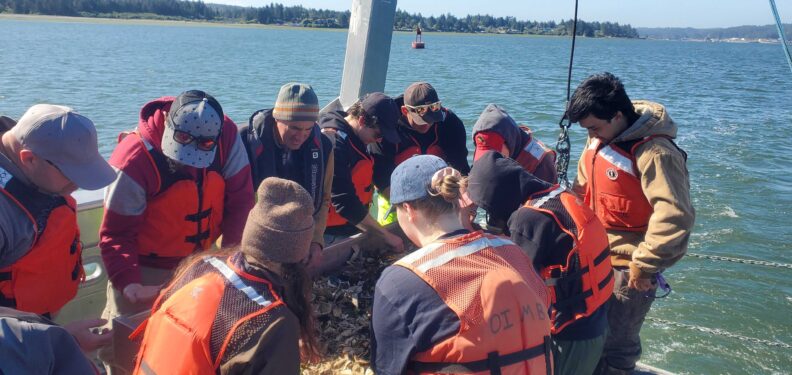
We found massive versions of creatures we’d seen in tidepools as well as creatures we hadn’t seen yet, such as leather stars (apparently, they smell like garlic, but the ones we pulled up weren’t of that sort). The group’s favorite was a red octopus no bigger than the palm of your hand. It did not appreciate the sudden influx of attention, so it got to hang out in a bucket of water for a bit before we released it.
Our second trawl was much less exciting, with the highlights being shrimp and living sand dollars. We traveled more inland for the second trawl, and it was fascinating to see how quickly the abundance and biodiversity dropped within this short distance. We did get to see seals lounging on the beach, as well as a flock of brown pelicans spectacularly diving into the water as they hunted. No minute aboard the Megalopa was wasted.
The winds picked up speed as we traveled back to OIMB, so many students chose to seek refuge in the cabin and drink some coffee or hot chocolate. The captain shared stories of his coast guard days. It was a peaceful ride back, and we were soon greeted by solid land and the promise of lunch. Scout saw us out, ensuring there were no stragglers left behind.
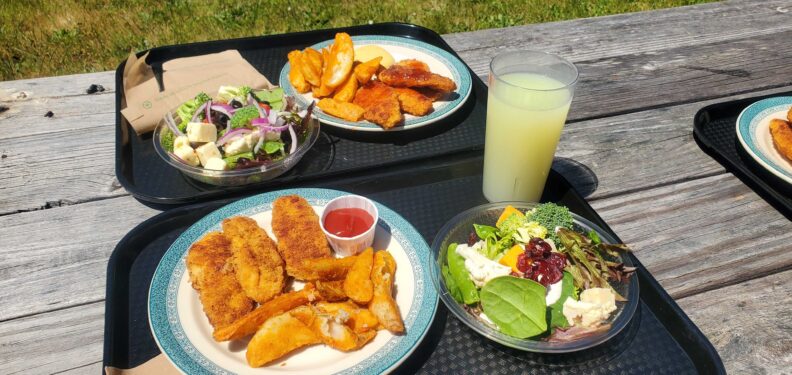
We took a moment to recover and refuel with some chicken strips and Jojos before the next half of our day.
Monday Afternoon – 18 May 2026
Cory Parker
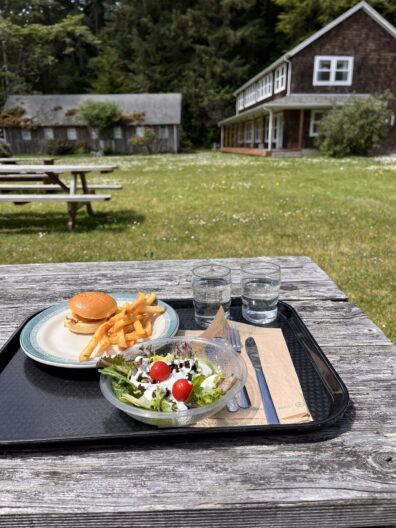
After returning from our nautical adventure aboard the R/V Megalopa, we returned to OIMB for another much-needed lunch. The weather has been unbelievably nice during our trip so far (other than the wind). Blue skies and sunshine convinced many of us to take advantage of the weather and eat outdoors at the picnic tables in the meadow behind the cafeteria.
After lunch, the class met back up and was invited to take a look at some of the research currently being conducted on campus. Graduate students Kersten and Miles introduced us to an ongoing experiment involving the Sunflower Sea Star, Pycnopodia. Populations of these impressive sea stars have dramatically declined throughout the Pacific Northwest since sea star wasting disease began spreading through the region in 2014.
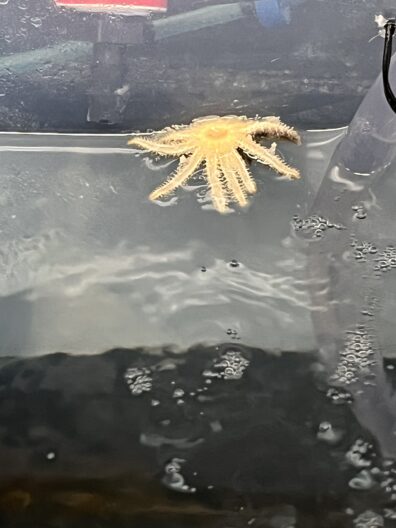
The graduate students explained that they had collected 20 sunflower stars during a dive expedition and have been monitoring them for changes based on a variety of experimental variables, beginning with diet. Miles described working with sunflower stars as an amazing experience, although he admitted they can be a bit like primadonnas. It was fascinating to hear firsthand about the challenges and rewards of working with a species that is both ecologically important and hopefully recovering from major population declines.
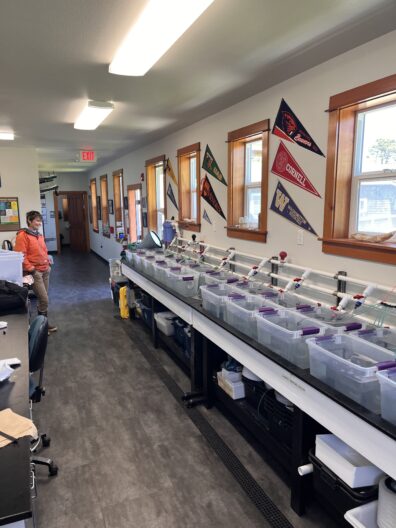
After visiting the research facility, we spent time working on our experimental design projects related to Cape Blanco and began drafting ideas that we will explore further tomorrow.
The afternoon concluded with a seminar titled How Cold-Water Fishes Survive Summer in Warm River Basins: Examples of Adaptive Capacity, presented by researchers from the Oregon State University Department of Fisheries, Wildlife, and Conservation Sciences.
Jonny Armstrong started the presentation strong with an image of a polar bear/salmon hybrid to launch a discussion about aquatic temperature tolerance. He highlighted several strategies salmonids use to deal with the challenges of warmer water temperatures and lower dissolved oxygen levels in river systems. The presentation ended with a question-and-answer session and a reminder that curiosity remains one of the most important parts of the scientific process.
Tuesday morning – 19 May 2026
Madalyn Denfeld
Tuesday morning started bright and early. We headed to the dining hall at 5am for a quick breakfast, then loaded up the van and began our 1-hour journey to Cape Blanco. We arrived around 7am and hiked down to the beach to get started on experiments for our independent research projects.
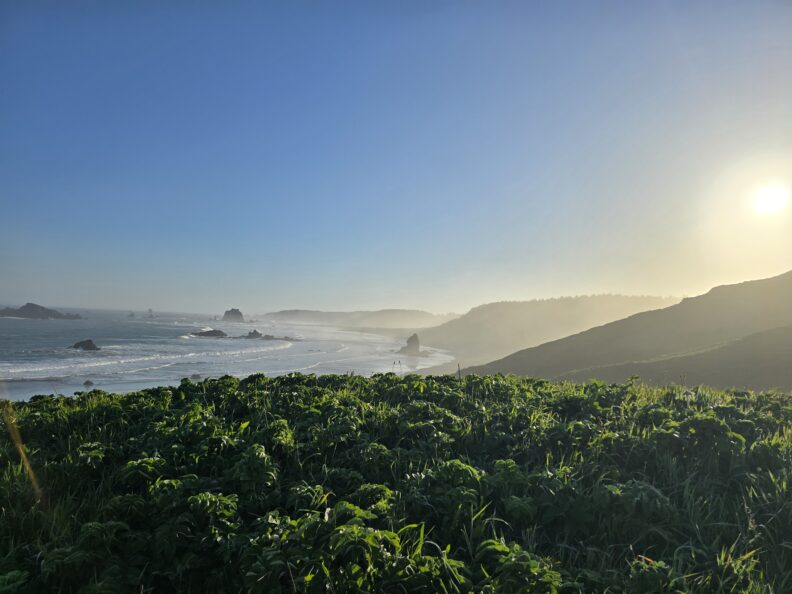
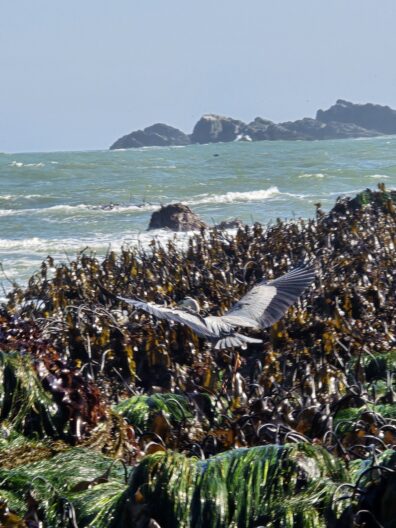
We got all of the gear organized and broke off into our groups to search for our various sea subjects, quickly realizing that the terrain is just a bit more slippery than we were used to from our previous sites. Through slips and falls, boots full of water, sore backs and sunburns, we persevered and spent hours collecting data and observing organisms in their natural habitats. We even got to see a few bonus creatures, like this Great Blue Heron that surprised us by swooping in for her lunch right next to us.
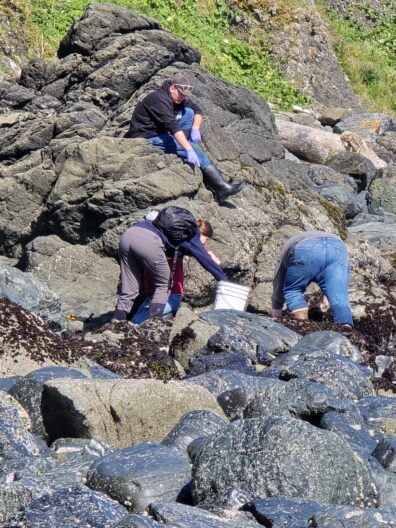
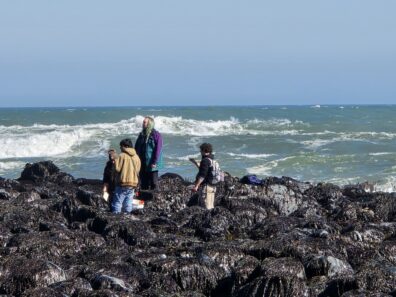
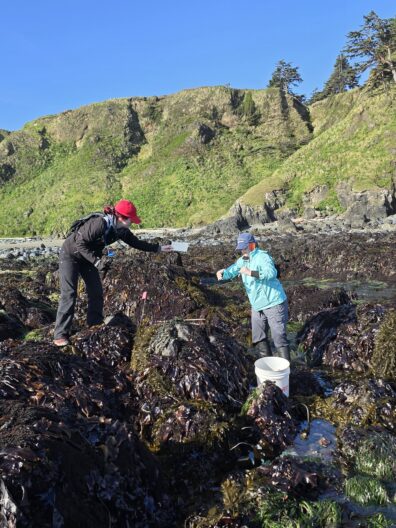
We all had to use a sight level to get our measurements, so we had an interesting time juggling custody of it, not to mention figuring out how to effectively communicate from across the beach; turns out, yelling can be pretty effective.
Once leaving time rolled around, one group hadn’t quite finished up collecting their data, and the tide was quickly moving in, so we got to demonstrate our teamwork skills. We worked together to find some extremely well-hidden anemones, and promptly poked them, because of science.
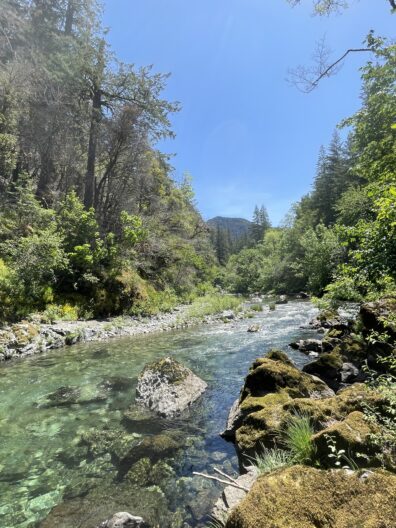
After we finished up with that, we packed up our gear and hiked it all out to the van then left for our next destination: Elk River Road. OIMB Staff was kind enough to pack us wonderful lunches, so we got to dry out in the sun (both clothes and bodies) and refuel our tired brains while the green-blue water rushed by below.
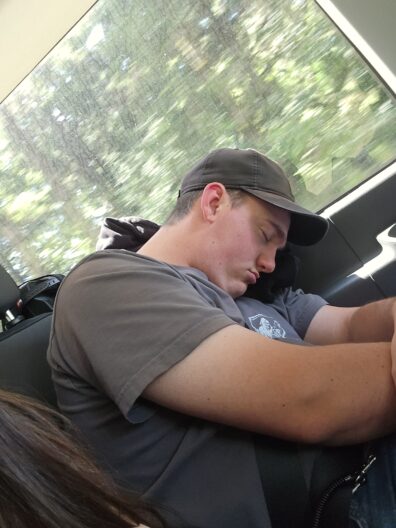
At this point, we were all equally full and tired, so we packed back into the van for our final hour and a half trek back to OIMB. Big thanks to Dr. Berger for staying alive, alert and enthusiastic to drive us all safely back to headquarters every day! On a parting note, for the recap of our morning escapades, please enjoy this photo of Colin snoozing on our way home.
Tuesday Afternoon – 19 May 2026
Tommy Workman
Today on Tuesday, May 19th, we finally went out to Cape Blanco to collect our field data.
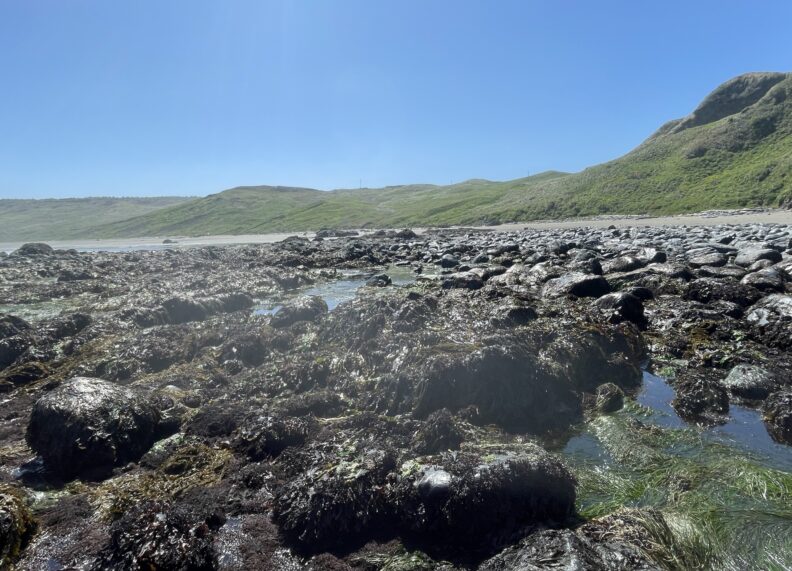
Our group’s research question is “what is the sea star (specifically Pisaster ochraceus, commonly known as the Purle Sea Star or the Ochre Sea star) population density in two different elevation sites within the intertidal zones, as well as what the mussel populations are in those same zones. We wanted to see what the long-term effects of Sea star Wasting Syndrome are in these coastal areas of Oregon, since so much of the sea star populations were decimated by this disease. This disease is caused by bacterial infections and causes parts of the sea star to severely deteriorate, which is noticeable by white wounds in the sea star.
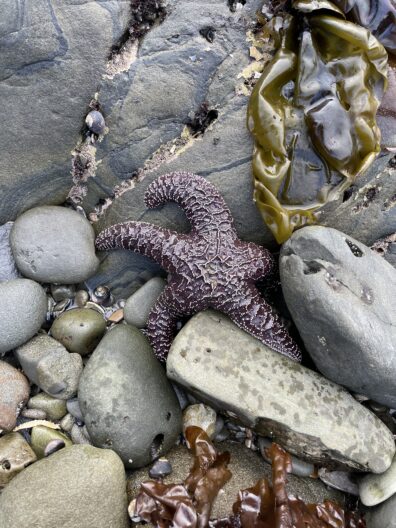
We included the mussel populations (with no specified species of interest) in our research question as P. ochraceus typically eats these mussels, as they are a large part of their natural diet. We wanted to see if there was a long-term effect of the sea stars’ absence and observe if there were a considerably large population of mussels in comparison to the sea stars that we observed. To conduct our research, we randomly selected six different sites in the intertidal zone (which is the area in which the tide covers and recedes away from throughout the day). Three of the sites were in the lower elevation area of the intertidal zone, and the other three were on the higher elevation area of the intertidal zone.
To create these zones, we measured a 10×10 meter area with a tape measure and counted each individual starfish we observed. For the mussels, we made an approximate estimate based on our average finding that roughly 95 mussels are found in a 20×20 cm zone and applied that math to larger areas which were measured in meters. In areas where mussels were sparse, I counted just each individual. We also measured the size of each sea star we found, by using calipers to measure their body diameter. We recorded that data, as well as each level of elevation each site was at.
We are still ongoing in our calculations, but we did gather enough data on both P. orchraceus and our mussel populations! Along the way of conducting our research, we also observed several anemones, crabs, and sea slugs. We even saw a few racoons and a and a marten scavenging for food in the tidepools!
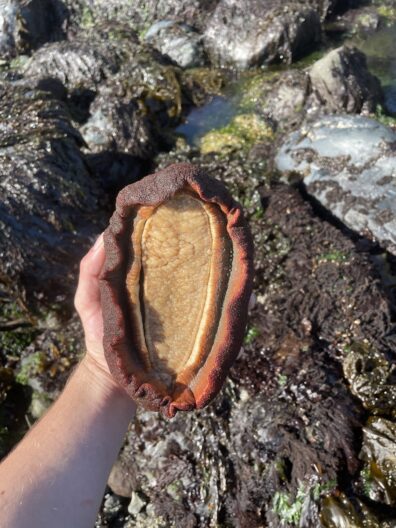
As we finished collecting our data, which took roughly from 7:00 AM to 11:00 AM, we helped another group collect data for their research question. The data in question was the size of the sea anemones diameter (Giant Green Sea Anemones, or Anthropleura xanthogrammica), and the contents of their stomachs. To figure out what was in their stomachs, we had to poke a finger in their mouth and see what was inside of them (they regenerate, so no serious harm was done). We helped to collect the last of their data just in time, as the tide was rapidly rising, and we got to finish up and pack everything out. We were able to stop at Elk Creek for lunch as well to enjoy some sandwiches!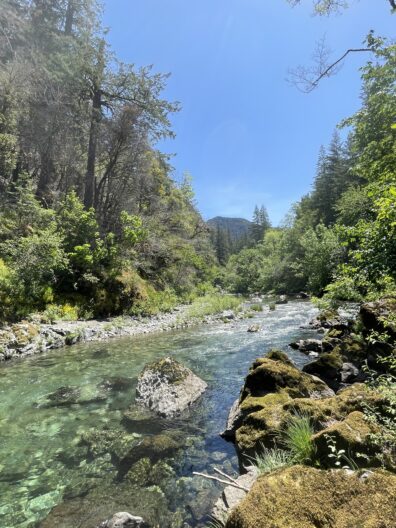
Wednesday Morning – 20 May 2026
Tom Wheeler
Wednesday morning began with a much needed lie-in, with most of us getting up between 7 and 7:15 am for breakfast at 7:30. After breakfast, around 8:00 am, we gathered in the classroom to gather supplies for the only lab of the day, sampling estuarine water at 3 different sites. After packing the sampling tools into two buckets and putting them (and ourselves) in the van, we headed off to our sites.
The first site was only a two-minute drive away, at the mouth of the river. It was next to the mud flats we sampled clams previously on Sunday, and just as muddy. With the sampling tools we’d brought, we measured the Temperature (°C), Salinity, pH, and Dissolved Oxygen. As expected of basically-seawater, it was quite salty, at 33 ppt.
Returning to the van after another quick jaunt over the flats, we headed off to our second measuring spot, a few kilometers up the estuary. This one was quite a drive away, and quite a walk too. We headed down switchback trails covered by trees whose branches interlocked overhead, forming an arch-shaped tunnel, sheltering us from the sun as we descended. The tunnel opened up to a boardwalk lined with salmonberry bushes that crossed picturesque salt flats. So picturesque in fact, that many of us stopped to commit the sight to digital memory.
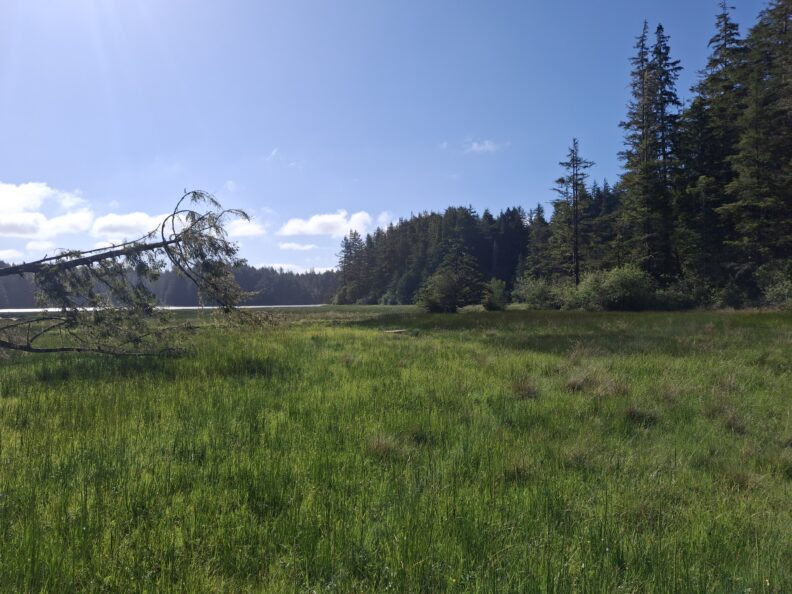
The boardwalk led to more forest trails, gradually leading downwards to an old dike barely wide enough for a single person to walk along without slipping onto the exposed muddy bed of the river to the right, or salt flats to the left. Given that it was around 10 am by this point, fairly close to low tide, the estuary’s waters were reduced to a trickle a foot or two wide; the riverbed was still quite present, and almost as muddy as it would be whilst still underwater. Colin braved the climb down the dike and squelched through the mud to get a water sample, which he brought back to the group to test as we did site 1. The salinity had dropped to 13 by this point, and the dissolved oxygen had decreased significantly too, though still breathable for most fish.
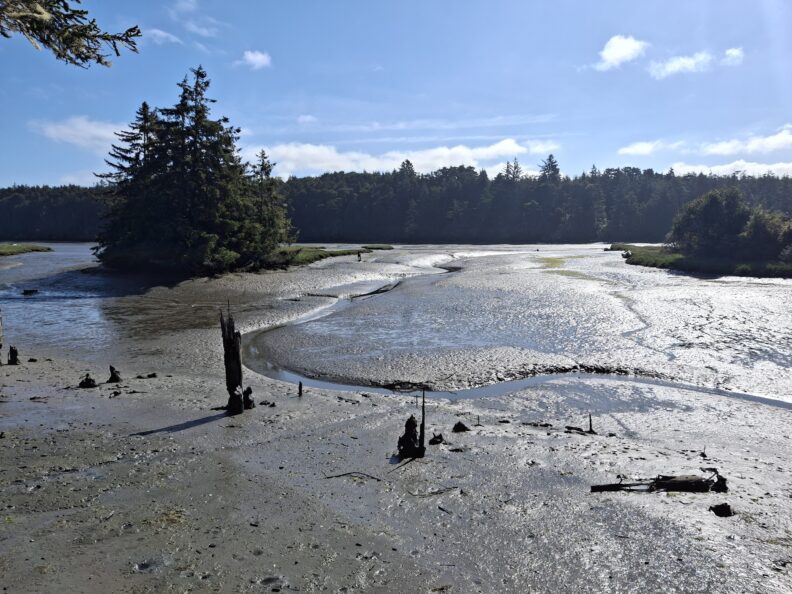
Once our sampling was done, we returned the water to the mud, sampled some pickle grass, and traveled back along the trail to the van. Given that it was mostly uphill going back, the journey was much more difficult, with the switchback trails being especially so.
The third spot was a shorter drive away, and the sampling site was an even shorter walk, only about 20 feet away. The estuary was practically unimpacted by the tides by this point, 6 km upriver, so the salinity had dropped to 0. The river was impacted enough though that it was a little lower on its banks than the muddy shore would suggest it usually rests at. With the tide higher, it likely would have been a bit higher too, as would the salinity.
We had some time before we needed to go back, so we searched up the road a little (by foot) for some pitcher plants that Dr. Berger remembered growing there, but it appeared that they had been superseded by skunk cabbage. We did stop to admire the forest and view of the (mostly not-salt) marsh.
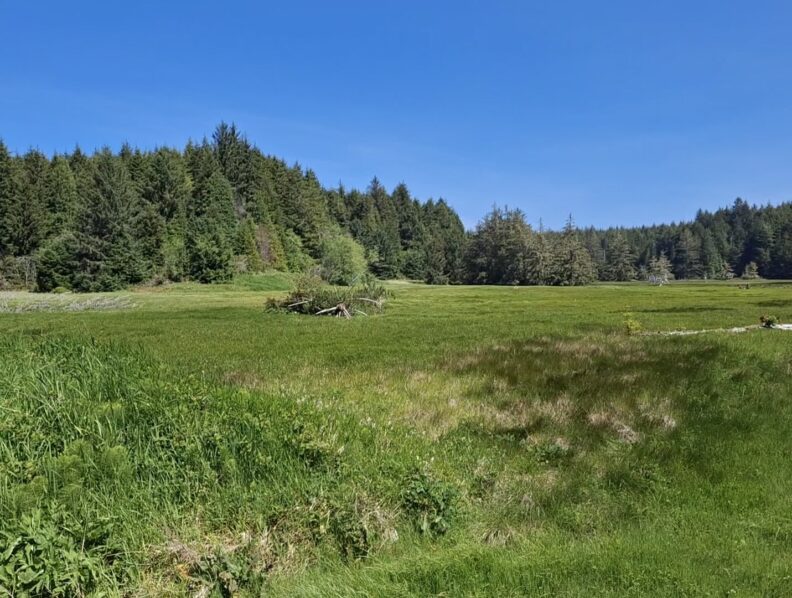
Piling back into the van, we headed back to OIMB for a short break and then lunch, which was an incredibly satisfying burger bar.
Wednesday Afternoon – 20 May 2026
Keodi Sinclair
After the beautiful burgers for lunch, it was time to release the collected specimens found over the days, observing them one more time before returning them back to their respective habitats; as we collected and separated the different organisms into different buckets we the split into 2 different groups to release them into their previous habitats – the mud flats and the harbor.
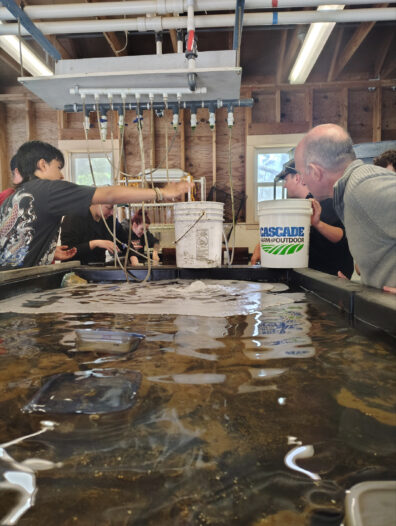
After that we decided to check out the Charleston Marine Life Center one last time as some of us had missed it, now having more appreciation and time to experience the history and interactiveness of the museum. We looked at different bones of sea mammals and birds, shells, fossils and fed the urchins and abalone some kelp.
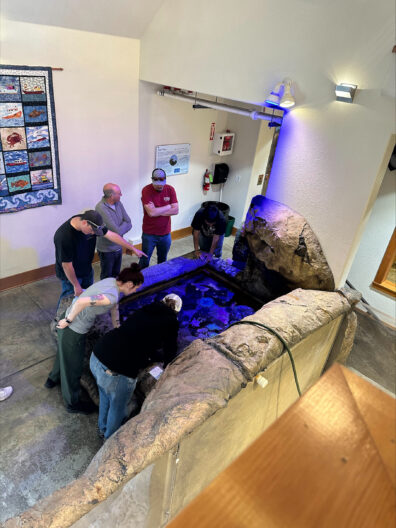
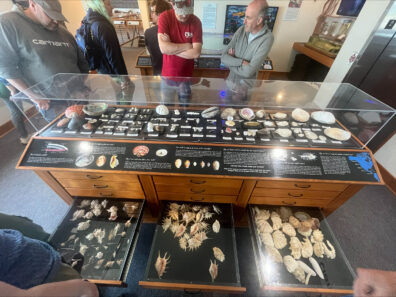
We all had free time for us to complete work, walk to the local stores, and take little hikes up until dinner which was beef pot pie, corn bread, cookies, and ice cream.
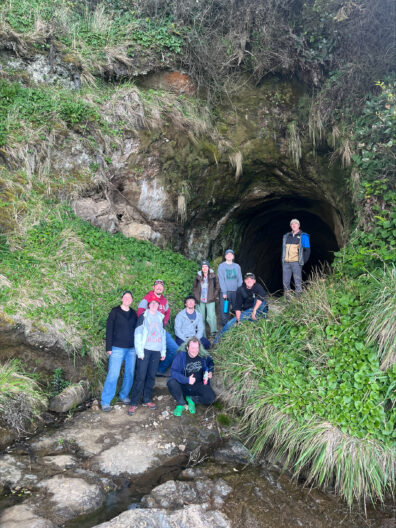
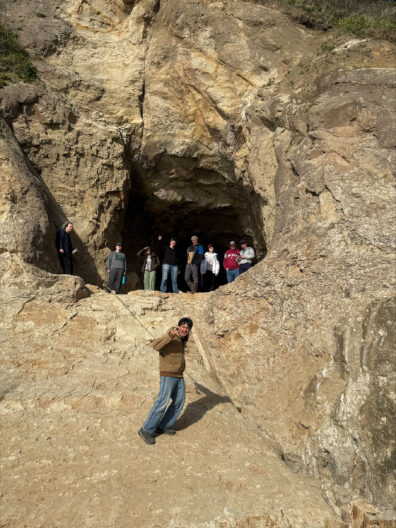
After many of us set off to walk and hike through the old tunnel looking at the geographical details in the sedimentary rocks, looking at the waves crash into the cracks of rocks, and the questionable unfortunate graffiti around, coming back ending the night with some studying and reminiscing on the past few days.
Thursday – 20 May 2026
Colin Mitchell
Thursday morning started later than most of the week, with everyone waking up around 7 a.m. to catch breakfast before heading out for one last excursion. Compared to some of our earlier mornings, it felt much more relaxed and gave everyone a chance to ease into the day before leaving around 9 a.m. for Cape Arago South Cove. We returned to the tide pools with a much better understanding of tidal environments than we had at the beginning of the trip. The weather was misty and overcast, but it was not too cold, which made for a really calm and comfortable morning along the coast.
Unlike some of our earlier outings, this visit was much more casual and reflective. We were not collecting specimens or gathering data this time, which made it easier to slow down and simply observe the environment around us. Having spent the week learning about zonation, species interactions, and how organisms adapt to the constantly changing tidal conditions, it felt different walking through the tide pools now. Small details that I probably would not have noticed earlier in the trip stood out much more clearly, and it was interesting seeing the habitat with a better understanding of how dynamic these coastal systems really are.
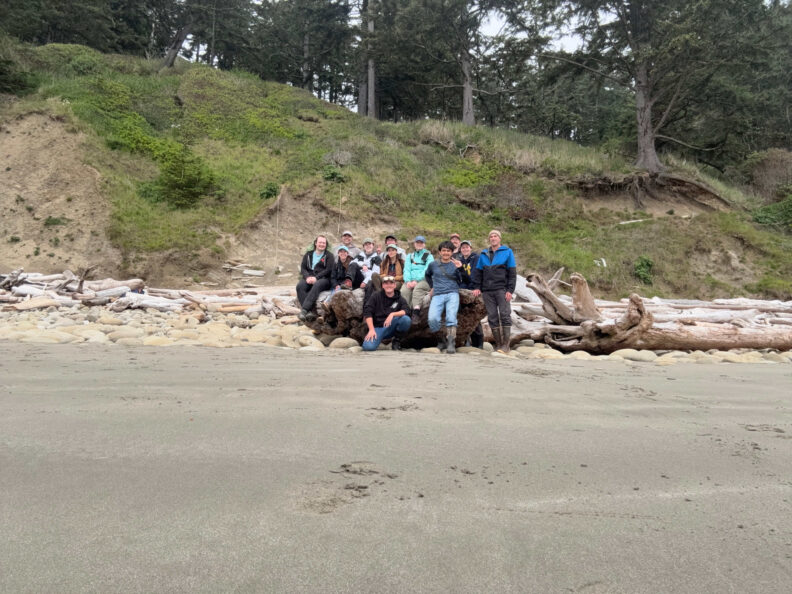
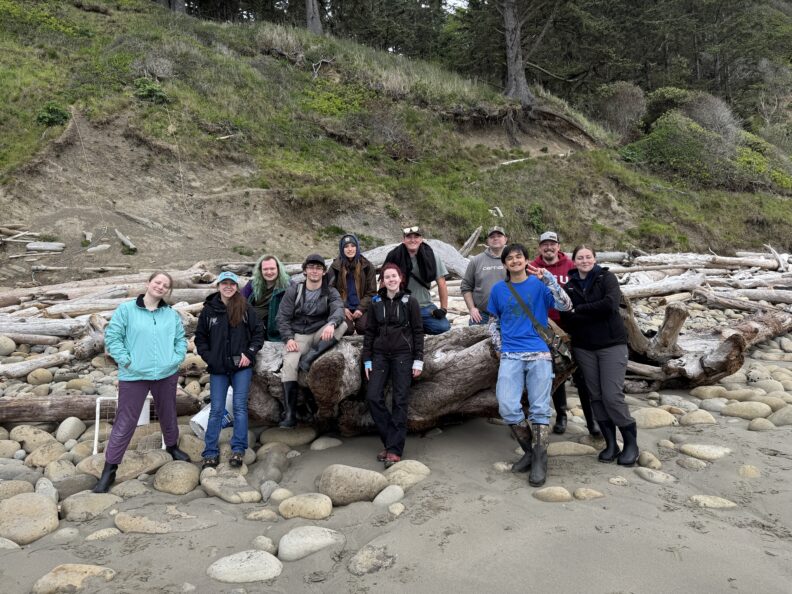
Overall, it was a really nice way to wrap up the field portion of the trip before heading home. The quiet weather, the tide pools, and the chance to revisit the cove one last time made for a good ending to the experience. Before leaving, we stopped to take a group picture on the beach, which felt like a fitting way to close out the week together after spending so much time learning and exploring along the coast.
Once we got back from South Cove, everyone returned to the cabins to start packing up, cleaning, and getting organized for the long trip home. After spending the week living and working together in the field, it felt strange seeing everything being packed away and the cabins slowly emptied out. Even though everyone was tired from the week, there was still a good atmosphere as people finished cleaning, loaded gear, and reflected on everything we had experienced over the course of the trip. By the time we finally headed out, it really felt like the end of an unforgettable field experience.
This concludes the Marine Invertebrate Communities Course Blog.